
 Skip Beckett
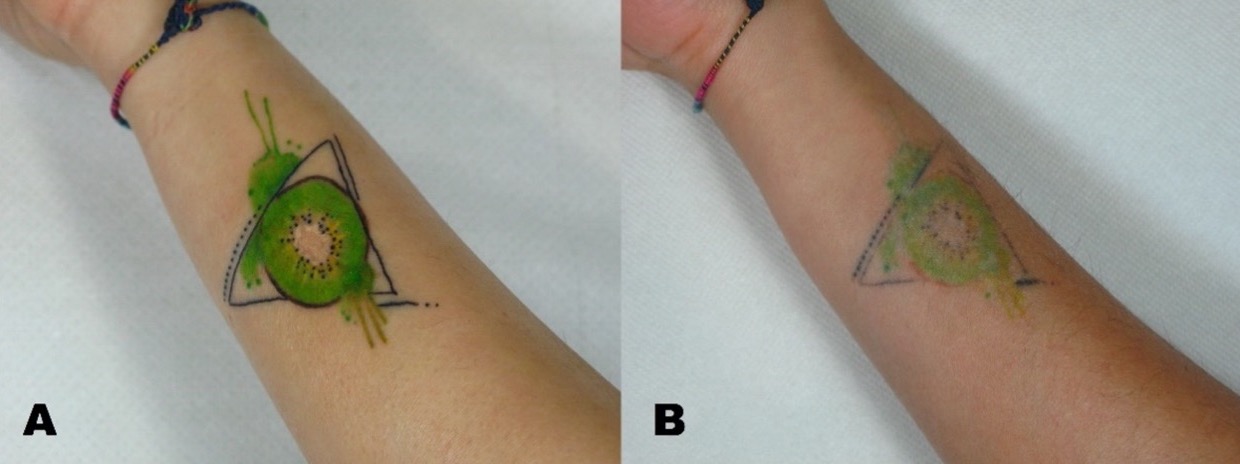
 Search “tattoo removal before and after” and you’ll get galleries full of dramatic transformations: a dark tattoo in the first photo, clear skin in the second. They’re compelling, and they’re also the reason a lot of people start treatment expecting more than removal can reliably deliver. Almost all of those images come from clinics, and a clinic shows its best work, the tattoos that responded beautifully, photographed in good light, often after a full and expensive course of treatment. What you rarely see is the average result, the partial fade, or the tattoo that never fully disappeared.
This is the honest version. Here’s what before-and-after results actually look like across a real course of treatment, what makes some tattoos clear well and others only fade, and how to set expectations you won’t be disappointed by.
Fading happens gradually, not between two photos
The biggest thing the two-photo format hides is time. A before-and-after image collapses months or years into a single side-by-side, which makes removal look faster and cleaner than it is. In reality, the change happens slowly, across many sessions spaced weeks apart, because the laser doesn’t remove the ink at all. It breaks the ink into fragments small enough for your body to carry away over the following weeks, and that gradual immune clearance is what you’re actually seeing between sessions.
So a truthful before-and-after isn’t two photos, it’s a slow sequence: a little lighter after the first session, a bit more after the second, the tattoo softening and graying over time. Most people need somewhere in the range of six to twelve sessions for significant clearing, and larger or more stubborn tattoos can take more. If you’re picturing a fast transformation, the honest reframe is this: removal is a long fade, not a quick erase.
What a good result actually looks like
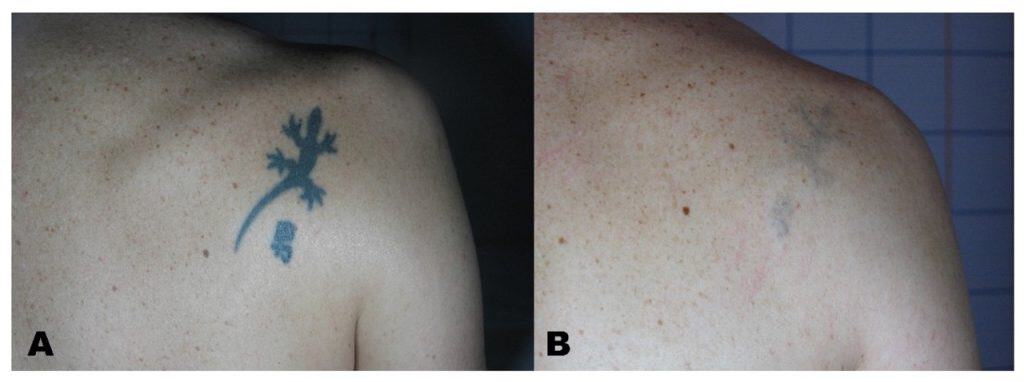
Here’s the part the galleries blur: for many people, the realistic goal isn’t blank skin. It’s significant fading. A strong result often means the tattoo is faded to the point where it’s barely noticeable in normal light, not that every trace of ink is gone. Black and dark tattoos tend to clear the most completely, since black absorbs laser energy best. Even then, some tattoos leave behind a faint shadow or outline, sometimes called “ghosting,” especially when the ink was heavily saturated or placed deep in the skin.
That’s not a failure of the treatment; it’s the normal range of outcomes. Some tattoos clear completely, many fade dramatically, and some fade substantially but not entirely. To put a real number on it: in one clinical study of 52 patients, complete clearance was achieved in about half, and a couple of cases were left with a faint residual “ghost” of the original tattoo. A provider being honest with you will describe the likely result as a range, not a guarantee, and that honesty is a good sign, not a red flag.
Why some tattoos clear better than others
The reason results vary so much from the galleries is that a handful of factors quietly decide how well any given tattoo responds. Color is a big one: black and dark blue clear most readily, while greens, light blues, yellows, and whites are more stubborn and may never fade as completely. Ink density matters too, a saturated professional piece with layered ink takes more sessions than a light amateur tattoo of the same size. Depth and placement play a role, as does your own body’s ability to clear the fragmented ink, which is why overall health and time between sessions affect the outcome.
None of this is visible in a before-and-after photo, which is exactly why the photos can mislead. Two people can get the “same” tattoo removed and end up with very different results, because their ink, skin, and biology aren’t the same.
How to read a before-and-after gallery honestly
Before-and-after galleries aren’t useless, they just need context. When you look at one, it helps to ask a few honest questions. How many sessions did that result take, and over how long? Was the tattoo black, or full of the stubborn colors yours might have? Is this the clinic’s typical result or its best one? A gallery that shows only flawless full-clearance cases is showing you its highlight reel. A more trustworthy source will show a range, including the partial fades, and will tell you how long each took.
The most useful before-and-after isn’t the most dramatic one. It’s the one closest to your tattoo, your colors, your skin, treated over a realistic number of sessions.
The honest bottom line
Real before-and-after results are more gradual, more variable, and often less total than the galleries suggest, and knowing that up front is what keeps the process from feeling disappointing. For most people, laser removal delivers significant fading over six to twelve or more sessions, complete clearance for many tattoos (especially black ones), and a realistic possibility of some faint residual ink. That’s a genuinely good outcome. It’s just not the two-photo miracle the internet tends to show. If you go in expecting a long, steady fade toward much-lighter or clear skin, rather than an instant erase, the actual results tend to look a lot like success.
A note on this guide
Tattoo Takeoff is an independent, research-based resource. It’s not a clinic and doesn’t perform removal, and nothing here is medical advice. Results vary widely from person to person; a qualified provider can give you a realistic assessment for your specific tattoo. If you’re considering removal, talk with a board-certified dermatologist or a qualified laser specialist.
Sources
U.S. Food and Drug Administration, “Tattoo Removal: Options and Results”
American Academy of Dermatology, “Tattoo removal: Lasers outshine other methods”
Journal of Cutaneous and Aesthetic Surgery, “Laser Tattoo Removal: A Clinical Update,” Ho & Goh
Last reviewed: July 05, 2026. Updated as we learn more.
